Showing posts with label sachin. Show all posts

Friday, December 25, 2009

Kohli recalls Sachin's call on U-19 WC


India's 2008 U-19 WC winning captain Virat Kohli said Sachin chipped in with advice before his team took on SA in the final match.

Kohli, who led India to victory in Malaysia last year, said, "Ahead of the ICC U-19 Cricket World Cup final, everyone back home was overwhelmed and believed we had a very good chance to win the trophy.

"Therefore, I started getting more telephone calls with everyone advising me to relax and not to panic, which actually put more pressure on me.

"However, the most special telephone call I received was from Sachin Tendulkar who was on the tour to Australia with Team India. He talked to me at length and advised me how I should approach the final," he said on this week's ICC Cricket World audio show.

In that fateful day, India were bowled out for a paltry 159 by South Africa in the final.
Reflecting on that day, Kohli said "I just told the boys that we have nothing left in the tournament except one last session. So, let's go out there and give all we have. We took the field to defend the small total with that killing instinct and rest is history.

Subscribe in a reader

Tuesday, December 22, 2009

"My career prospered under Tendulkar"


Sachin Tendulkar may not have been a huge success as India captain but many a young career bloomed under him, said Sourav Ganguly.

"When I was trying to find my feet in international cricket, it was a huge learning experience to play under Tendulkar. He had given a lot of support as a player and as a captain and my career blossomed under him," Ganguly said on the sidelines of a Tendulkar felicitaion on Tuesday.

"It's not only me, I am sure the likes of (Rahul) Dravids, (VVS) Laxmans and (Anil) Kumbles would be thinking the same about Tendulkar," Ganguly said at the ceremony organised by the Aryan Club that celebrated its 125th anniversary.

Sachin turned out for the Aryans in the early 90s in the P Sen Trophy.
Recalling his association with Tendulkar, Ganguly said, "I know him since my under-13 days when we met at a national camp. It has been a long journey together. We had a very good time together at the top, opening the batting in ODIs.

"He has charmed the crowd not only with his bat but with his amazing behaviour. It's very difficult to emulate what Sachin has achieved as a cricketer and the talent he possesses. But it will be really nice if we could emulate him the way he carries himself," Ganguly said.
Ganguly wished Tendulkar remained fit to achieve 100 international centuries and do well in the 2011 World Cup.

"World Cup is coming and he is also close to 100 centuries. I wish he remains fit and bats the way he is doing. It's an example for the youngsters to follow," Ganguly said.

He also congratulated Sachin for his bit to make India the number one Test side.
"I remember when we used to tour overseas, were being levelled as very soft, not because of his batting but soft for our team's performance. I congratulate him on achieving the No 1 status and he is the biggest contributor to that," Ganguly said.

Subscribe in a reader

Monday, December 21, 2009

Tendulkar, Jadeja lead India canter


Ravindra Jadeja claimed a career-best four-wicket haul, while Sachin Tendulkar struck a superbly-paced 96 not out to lead India to an easy victory.

Sachin Tendulkar struck a superbly-paced 96 not out as India secured an easy seven-wicket victory over Sri Lanka in the third one-dayer in Cuttack to take a 2-1 lead in the five-match series.

Sri Lanka won the toss and Tillakaratne Dilshan gave the visitors a flying start with a brutal 18-ball 41, while Upul Tharanga (73) and Kumar Sangakkara (46) kept Sri Lanka in line for a big total.

However, Ravindra Jadeja claimed a career-best four for 32 as India's bowlers fought back bravely to restrict Sri Lanka to 239 all out.

Stand-in skipper Virender Sehwag (44) gave India's chase a solid start but Tendulkar's calm innings ensured they were never in danger as the home side overhauled the target with 7.2 overs to spare.

Sri Lanka's total had seemed unlikely at the start when India's new-ball bowlers Zaheer Khan and Ishant Sharma leaked runs, coming unstuck as much from their own lack of accuracy as Dilshan's free-hitting intent.

A flurry of boundaries helped Sri Lanka raise the 50 off only 26 deliveries and the opening batsmen added 15 more to the total before first-change bowler Ashish Nehra, along with Harbhajan Singh, pulled things back.

Harbhajan, pressed into action inside the powerplay, bowled a tight line, while Nehra engineered the breakthrough by ending Dilshan's stay.

The dashing opener, who was let off on 36 when Dinesh Karthik made a mess of a stumping chance, top-edged a pull that Karthik easily held.

There was little respite for the home team, however, as Sangakkara and Tharanga built steadily.

The two added an even 100 for the second wicket when Sehwag lured Sangakkara, beat him with turn and Karthik completed a stumping after first failing to collect cleanly.

Sri Lanka were 165 for one in 22.2 overs at that stage but India's bowlers effected a stunning turnaround.

Jadeja snared Tharanga with one that turned sharply from outside off and Mahela Jayawardene perished while attempting to pull a short delivery from Harbhajan but only found Suresh Raina at short midwicket.

Thilina Kandamby (22) and Chamara Kapugedera (15) briefly steadied the innings but Jadeja nipped that stand in the bud by bowling Kapugedera via an inside edge and Kandamby - the last recognised batsman - was also scalped by Ishant, the bowler making further amends for a wayward opening spell by removing Suraj Randiv for a duck in the same over.

The tail went quickly and Jadeja finished his spell with the wickets of Nuwan Kulasekara and Ajantha Mendis.

Sehwag, after a quiet start, responded with a stroke-filled innings, dominating an opening stand worth 55 with Tendulkar.

He had hit nine boundaries in a 28-ball stay when he attempted to cut Chanaka Welegedara for another boundary but only found Dilshan at point.

Gautam Gambhir (32) continued the chase and had added 72 for the second wicket with Tendulkar when off-spinner Suraj Randiv, playing only his second ODI, produced a smart catch off his own bowling to send back the left-handed batsman.

Tendulkar, off the mark with a superbly-timed boundary through midwicket, was again the common factor in a stand worth 42 for the third wicket with Yuvraj Singh (23).

Tendulkar, who struck 13 boundaries, then put on 73 in an undefeated stand for the fourth wicket with Karthik (36 not out) as India cantered over the line.

Teams:

India: V Sehwag*, SR Tendulkar, G Gambhir, Yuvraj Singh, SK Raina, KD Karthik†, RA Jadeja, Harbhajan Singh, Z Khan, A Nehra, I Sharma.

Sri Lanka: WU Tharanga, TM Dilshan, KC Sangakkara*†, DPMD Jayawardene, SHT Kandamby, CK Kapugedera, S Randiv, KMDN Kulasekara, BAW Mendis, UWMBCA Welegedara, SL Malinga.

Subscribe in a reader

Sunday, November 22, 2009

Shiv Sena slams Tendulkar again


Shiv Sena on Sunday unleashed another attack on Sachin Tendulkar and compared him with Sunil Gavaskar who it hailed as a "true Maharashtrian".
The attack came in an article in party mouthpiece 'Saamna' by Sena MP Sanjay Raut days after party supremo Bal Thackeray accused the 36-year-old cricket icon of hurting Marathi sentiments with his "Mumbai for all" remark.

Comparing Tendulkar to Gavaskar (60), Raut alleged, "There has been no instance of Sachin extending a helping hand to other Marathi cricketers. Forget others, he did not even support Vinod Kambli."

"In contrast, Gavaskar when he captained India, had half the team drawn from Mumbai and Maharashtra. He gave Test caps to many Marathi players including Suru Naik and Zulphikar Parkar at least for one match," he said, while also acknowledging Tendulkar's greatness as a cricketer.

"In this context, Gavaskar is a genuine 'Maharashtrian' and the whole country loves him even now in the same way," the article claimed.

"Players like Sachin have become rich because of game of cricket. Sachin's wealth has crossed Rs 200-crore mark. We expect Sachin to be as 'proud' of Maharashtra as Saurav Ganguly is of Bengal," it said. "Rahul Dravid too is a Marathi player but he is loyal to Karnataka," Raut said.

Thackeray's remarks on November 16 had evoked angry reactions from a host of political leaders as also the BCCI, who came down heavily on the Shiv Sena chief for criticising Tendulkar, saying his statement was just right and nobody could take objection to it.

Subscribe in a reader

Saturday, November 21, 2009

Sachin's first words; his first political stand

With his ‘Mumbai for all’ statement, Tendulkar finally took a political stand, striking a chord with Ali and Owens. But what is it that deters our sportsmen from being politically outspoken?

After keeping quiet for two decades on anything that appeared even remotely sensitive, last week Sachin Tendulkar delivered his version of Ali’s I ain’t got no quarrel with them Vietcong remark. "Mumbai belongs to India, that’s how I look at it. I’m extremely proud to be a Maharashtrian, but I am an Indian first," said Tendulkar.

The Mumbai-for-all remark was a departure from all those years of silence. And it’s not just Tendulkar. If Indian sports stars have a common trait, it’s being apolitical. So why did he take this figurative leap that evening? No one can answer that except Tendulkar. But whatever the cause, the remark got the Shiv Sena chief all worked up. He warned Tendulkar "to keep off the political pitch" for his own well-being. Tendulkar may have angered Bal Thackeray, but with his one statement he aligned himself with the Muhammad Ali and the Jesse Owens of the sporting world. His words became representative of larger constituencies. And by speaking his mind, many say, he reinvented himself.

Tendulkar’s silence, and now his statement, only reiterates an abiding question: why has India, which has seen wars and riots, battled communalism and casteism, failed to produce a sports icon of defiance? For all the sportsmen and women who have come from humble backgrounds and oppressed classes, why have we not produced any symbol of protest? Why don’t we have an Ali?

"This is a major failure of Indian sports," says sociologist Ashis Nandy. "During the colonial times we were brainwashed into believing that sports was apolitical in nature. That it was not right to let politics enter sports." And even after Independence, Nandy says, we didn’t change. "The only politics which seemed valid to us was the politics of nationalism. Apart from the time when India refused to play with South Africa because of apartheid, we’ve never been political," he says.

In 1975, when the Emergency was clamped, "writers, artists, social scientists protested" but bureaucrats and sportsmen kept away. "Sportspersons did not open their mouths during the anti-Sikh riots or during the Gujarat riots," says Nandy.

But sportsmen steering away from politics is perhaps a trend that’s not limited to India. Says Prof Vinay Lal, lecturer of history at the University of California, Los Angeles, and author of Of Cricket, Guiness and Gandhi: Essays on Indian History and Culture: "It is true that our sportsmen and sportswomen have never taken strong stands on political matters, but I would say that this is by and large the case all over the world. The case of Muhammad Ali might seem different but Ali had converted to Islam, and, in some respects, had already become marginal to American society. Even without the conversion, let us not forget that as a black man Ali already stood at the margins, and therefore was emboldened to take some risks".

Lal says the example of Jesse Owens too has to be viewed within broader geopolitics. Owens became a living repudiation of Nazi racial ideology and "was almost thrust into becoming a political symbol". Lal adds: "I think we would be hardpressed to find white sportsmen and sportswomen in the West who have been spokespersons, eloquent or otherwise, against injustice, discrimination, and racism."

Both Ali and Jesse Owens became symbols of the fight against injustice and racial oppression with the "knowledge that they had, or would have, a world audience".

Indian sportspersons, on the other hand, lack that visibility on a global platform. "I suspect also that they have only in recent years come into money in a big way, and they are probably loath to jeopardise their commercial interests by appearing to take political positions," says Lal.

Ace shooter Abhinav Bindra agrees. Sportspersons need the support of the establishment. "Trying to support even non-sports issues could come in the way of your progress. Let’s focus on producing world class sports icons. When we do that, hopefully we’ll be able to produce sports icons of defiance," he says.

Social scientist Shiv Visvanathan points out that Indian sports may not have a symbol of protest at present but it has had sportspersons in the past who have spoken their minds. "There was Ranjit Singh and Duleep Singh, who objected to Bodyline. Lala Amarnath too. But that was during the colonial era," says Visvanathan. "None of our sportsmen had strong political views after that. There are cricketers and others now who wear a black band for AIDS and tiger conservation but that’s social work and not a political statement." Cricket, in particular, and sports in general in India, is a sign of mobility rather than a search for justice, Visvanathan says.

"When Mohun Bagan beat the British football team (East Yorkshire Regiment, 1911 IFA Shield final), it was a political statement against the Queen. In 1936, when Dhyan Chand’s team beat the Nazis, it was a statement. Post Independence there were no statements. It started changing from 1960. Commercialisation killed it," insists Visvanathan.

Of course, Sunil Gavaskar refusing the MCC membership in 1990 because a steward had once returned him from the gates of Lord’s, too can be considered to be a political statement of sorts, but it was Sourav Ganguly’s shirt-waving on the Lord’s balcony that captured the imagination, post-Independence.

"He understood the symbolism of politics," says Visvanathan of Ganguly.

"Taking his shirt off at the Natwest Trophy was a political statement against the Whites. By removing his shirt, Ganguly said we got a six-pack mentality of cricket. Bhutia is another example but he is a meek fighter and sports is anyway regionalised in India. Hockey is not big enough now. It will not capture the imagination if some hockey player was to revolt. So Indian sports is a politics of a silent movie. There is no speech involved here," adds the sociologist.

But do sports fans want sports stars to have political views? "It’s unfair to expect sports stars - many of them who have never gone to college - to be idealists of society. They don’t have the intellectual bandwidth, and worse, they might even mess it up if they speak on certain sensitive issues," says historian Ramchandra Guha.

But there have been some exceptions. Jaipal Singh, a Munda tribal who captained the Indian hockey team to gold at the 1928 Amsterdam Olympics, was one of them but he remains largely forgotten. He formed the Adivasi Mahasabha - later to be known as the Jharkhand Party. An active leader of the Adivasi cause, as a Member of Parliament in the 1950s, he lobbied for the rights of the scheduled tribes and the demand for a separate state, which was realized in 2000 when Jharkhand was carved out of Bihar.

Even before Jaipal, there was an Indian sportsperson who did play such a role, one whose exploits were chronicled in Guha’s A Corner of a Foreign Field. In his seminal chapter ‘Caste’, Guha writes on Palwankar Baloo, an "untouchable" who bowled left-arm spin and is regarded as the first great cricketer produced by India.

In 1915, in the Quadrangular for the Hindu-Parsi match, when Baloo was dropped, protests were held all across Mumbai, accusing the Hindu selection committee of having conspired to throw Baloo out. In 1919, there were similar controversies surrounding Baloo but he played after much furore. "From 1895, when Baloo first began playing competitive cricket, the Palwankar brothers - Baloo, Vithal and Shivram - had struggled to be included in mixed teams, struggled to be served tea and cakes in the cups and plates used by their fellows, struggled to be rewarded with the leadership status their achievement had called for. The 1920 Quadrangular was their most substantial social victory to date," writes Guha.

"In that sense, Baloo is the only sports icon of defiance India has produced so far. He initiated talks between Gandhi and Ambedkar and also mediated between them," he adds.

In the Nineties, Tendulkar was a messiah who was supposed to salve the wounded pride of a nation by scoring runs. "There were such silly expectations in the ’90s surrounding Tendulkar. He had to score runs and give Indian people a false sense of success," says Guha.

In his 20th year of playing in international cricket, Tendulkar might have turned a corner and realised that in an India so starkly different from the ’90s, it is not enough for a man of his stature merely to score runs. He needs to go beyond the boundary, rise above the surrounding parochialism, enlist himself as the member of the world religion and become the transcendent athlete. That Friday evening when he said "Mumbai for all" was the day he took the first baby step towards it.

Subscribe in a reader

Thursday, November 19, 2009

Sachin to play T20 cricket in England


Sachin Tendulkar is expected to be signed up by England county Middlesex to play Twenty20 cricket for them next season, The Guardian reports.
Former Australian wicketkeeper and Deccan Chargers skipper Adam Gilchrist will also play the shortets format for the county next year.

According to The Guardian, the deals, which would be partly funded by the MCC, would engage the players to play five T20 games, all of them at Lord's.

"We expect to make an announcement shortly. The two clubs (MCC and Middlesex) are working closely together," MCC's chief executive Keith Bradshaw was quoted as saying.

Tendulkar, who completed 20 years in international cricket on November 15 will return to the England county circuit after playing for Yorkshire in 1992 as a 19-year-old.

However, this will be the first county stint for Gilly, who has never played domestic cricket in England and has been involved with current IPL champions Deccan Chargers.

"Gilchrist, a member of the MCC's world cricket committee, may extend his affiliation with the MCC beyond the end of the Twenty20 Cup, and he is expected to play for Middlesex against the Australians before their one-day series against England.

The signing of two such internationally renowned players would be extremely lucrative for the MCC, who are currently exploring ways to finance a 400 million pound redevelopment plan", The Guardian went on to add in its report.

Subscribe in a reader

Monday, November 16, 2009

India blasts Thackeray for taking on Sachin

New Delhi: India's political establishment on Monday joined the cricket board to slam Shiv Sena leader Bal Thackeray after he criticised cricket icon Sachin Tendulkar's "Mumbai belongs to all" comment.

From the Bharatiya Janata Party (BJP), otherwise a Shiv Sena ally, to the perenially critical Communist Party of India-Marxist (CPI-M), the entire political class said that Thackeray's hard-hitting attack on Tendulkar was uncalled for.

In a signed, open letter to the cricketer published in the Shiv Sena mouthpiece Saamna on Monday, Thackeray said his "friendly advice" to Tendulkar was that he should "concentrate on international pitch" and stay away from politics for his "own well-being".

Thackeray, whose party suffered a rout in last month's assembly elections in Maharashtra, took umbrage at the cricket maestro's statement last week that he was "a proud Maharashtrian but an Indian first" and "Mumbai belongs to all".

That comment followed widespread criticism of the Maharashtra Navnirman Sena (MNS) and Shiv Sena for the assault on Samajwadi Party MP Abu Azmi for taking oath in the Maharashtra assembly in Hindi. A furious Thackeray said that players like Tendulkar "ultimately play only for themselves".

In no time, voices across India, a country which is celebrating 20 years of Tendulkar's glorious career that has made him a cricket legend, hit out at the 83-year-old Shiv Sena founder leader.

The Board of Control for Cricket in India (BCCI) said Thackeray's remarks were needless.

Said BCCI spokesperson Rajiv Shukla: "It is completely uncalled for. They (Shiv Sena) have no business to talk like this. Tell me what crime Sachin has done? What is wrong in saying that 'I am an Indian and Mumbai belongs to all'... No Marathi will support Shiv Sena if they talk like this."

A day after the Rashtriya Swayamsewak Sangh (RSS) denounced linguistic chauvinism, the BJP simply refused to side with the Shiv Sena. Party leader Arun Jaitley told reporters here: "If any Maharashtrian says he is proud of being a Maharashtrian as well as an Indian, then I find this statement absolutely correct."

The Congress did not spare the Shiv Sena. Its spokesman Abhishek Singhvi said: "He (Thackeray) should be the last person to preach to a gentleman cricketer like Sachin Tendulkar."

Minister of State for External Affairs Shashi Tharoor said on Tweet: "On Sachin and Sena, my late dad Chandran Tharoor said in '66: 'With Maharashtra for Maharashtrians and Kashmir for Kashmiris, where is India for Indians'?"

Bihar Chief Minister Nitish Kumar, a BJP ally, also made clear his displeasure. "Shiv Sena is on the wrong foot in criticising Sachin Tendulkar," said the Janata Dal-Secular leader.

Rashtriya Janata Dal (RJD) leader Lalu Prasad and the CPI-M politburo member Brinda Karat also did not spare Thackeray. Karat said: "Thackeray's comments are completely uncalled for."

The sporting community also rallied behind Tendulkar.

Said Olympian Milkha Singh: "Whatever Sachin has said is completely right. India comes first and the state comes later. Sport and politics should not be mixed."

In his Saamna article, Thackeray said: "You are free to hit fours and sixers on the cricket field, but keep off the political pitch." Tendulkar grew up in Thackeray's neighbourhood in Bandra East and learnt his first cricket lessons there.

"With (your) one statement, you became 'run out' in the pitch of Marathi minds," the Shiv Sena leader said.

The Maharashtra Navnirman Sena (MNS), otherwise a more radical Marathi outfit, did not react. Sanjay Raut, editor of the Saamna newspaper, defended Thackeray.

"Bal Thackeray has not said anything wrong," he said. "We also believe that the nation comes first. That is why we say 'Jai Hind, Jai Maharashtra'."

Subscribe in a reader

Sachin fascinated by Richards shot


In an exclusive interview to SportsCenter’s Sai Prasad Mohapatra, Sachin Tendulkar speaks about the stroke he feels is missing from his bag.

With approximately 30,000 runs in international cricket and 87 international hundreds in the game you might think that Sachin Tendulkar should be a content man. But, he isn't. When Sachin was asked what was the stroke he still yearned for, he said, "Vivian Richards' flick towards the mid-wicket."

The master batsman was referring to the famous plant of the foot of the former West Indian captain Richards on the off stump and his contemptuous flick to midwicket to even the fastest bowlers in the world.

"I think it was a terrific stroke," was how Tendulkar described the stroke.
Tendulkar is known not to cringe or shy away from challenges and when asked if there was a bowler from an era before he started playing whom he would like to face, he picked the most challenging set.

"I have never thought on these lines but I think it has to be the West Indian pace quartet," he said, referring to Joel Garner, Andy Roberts, Michael Holding and the late Malcom Marshall.

Tendulkar, who famously opened the batting in a One-day International for the first time in 1994, recalls that game as one of the milestones in his career.
"I had played a lot of important knocks in ODIs till then but I think a lot changed after I started opening in one-dayers that day (during the 1994 tour of New Zealand).
"I was playing the new ball every second day and that helped me in the Test matches as well as I was now looking to score in the longer version of the game," the batting icon said.

And, what knocks he would want to replay if he was given a chance? "2003 World Cup final against Australia, 1999 Chennai Test match against Pakistan when I got out for 136 and may be the 175 against Australia in Hyderabad," he said.

Subscribe in a reader

Saturday, November 14, 2009

Sachin, greatness that goes beyond cricket

Just when the Berlin Wall was being broken down 20 years ago, the cricketing world started talking about a boy wonder who would rise to be a cricketing colossus. Two decades in sport is more than a generation and Sachin Tendulkar carries on and on--not wanting to think about the day he would have to stop playing the game.

Everyone who writes about cricket has to write about Tendulkar. The two are inseparable entities. It clearly underscores the fact that he is one of the greatest cricketers and in modern day parlance an entertainer par excellence with the highest TRP rating because he scores runs by tons with relentless brilliance.

Tendulkar's greatest quality is--whatever he might say about his pre-match nervous energy--that he has an air of deliberate confidence before he goes in to bat that he is going to make runs. And make runs he did with regularity. This uncanny ability places him a cut above two of his contemporaries whose names are invariably taken in the same breath, Brian Lara and Ricky Ponting. But both admit that Tendulkar has something extra that makes him stand out.

The greatness of Tendulkar is that he spreads his skill through his teammates, lifting their morale and competence. Anyone who has played with him swears that he has benefited by his ability to transmit the knowledge about the game. Every player, who has shared with him the dressing room, struggles for words to describe the genius of the man. He is beyond their comprehension.

If ever a player has overshadowed him, for sheer class of batsmanship, it is V V S Laxman. After a record 353-run fourth-wicket partnership in the 2004 Sydney Test when Laxman hit 30 fours in his 178 to Tendulkar's 33 in his unbeaten 241, the master put the artistry of V V S in perspective.

"When Laxman was playing those shots, I decided it was best to just watch and enjoy his batting rather than try to do what he was doing."

Tendulkar made quite a few subtle and not so subtle corrections in his batting from time to time to suit his physical ability. There are some hundreds of his wherein he chose to drag his second fifty inexplicably after reaching the first fifty in no time. He sought to justify that the bowling was of top class or that he was playing in the interests of the team. It is difficult to agree that any bowling could chain him.

Looking at the unabashed praise lavished at Tendulkar it may appear he has few failings, both as cricketer and person. None of his contemporaries or his huge league of admirers, including some greats of the game, seems to find any human weakness in him. This is quite unlike Don Bradman who was not spared by his teammates who found chinks in his persona even as they praised him sky-high as a cricketer. Sachin, his admirers say, is more humane and likeable, though as captain he was too stubborn, refusing to deviate from his pet fads.

Watching him these 20 years was one of the pleasures of making a living watching sport. Memories take one back to New Zealand in 1989-90, Tendulkar's second international tour after the debut one to Pakistan a couple of months earlier under a different captain. Those were the days when on tours there was not so much of nitpicking by the media and the teenager got all the protection he needed.

Seldom has a player caught the imagination of a country as he did on that tour. He was the talking point wherever people discussed cricket. "What's special about that kid," the cabbies wanted to know and "I can't imagine a 16-year-old facing Richard Hadlee who has taken 400 Test wickets," said an amateur painter as he sketched the ambience of Christchurch, the garden city with Gothic architecture in South Island, as a memento to be given to him.

Twelve years down the road in an interviewed at Harare, he was a confident young man. He knew what to expect from the media and how to sidestep uncomfortable questions. Asked about the two captains he played under, he would say he had played only under Azharuddin and it was too early to assess Sourav Ganguly. Anticipating the next question, he hastened to add that the '92 side was the best team he had played in.

The only time he was irked by criticism was when, in the aftermath of the World Cup disaster in the Caribbean two years ago, there were shrill calls in the media for his head. He took on coach Greg Chappell and the Indian cricket board asked him to show cause for his outbursts. Otherwise, he always let his bat do the talking and it silenced and shamed his critics.

He continues to make politically correct statements, though, for once, he did not mince words on Marathi Manoos, saying that he was a proud Maharashtrian, but an Indian first, and that Mumbai belongs to India.

Perhaps, Tendulkar from now on will be taken seriously when he speaks on subjects other than cricket.

Subscribe in a reader

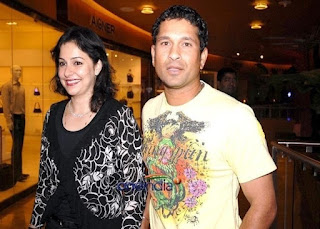
I don't even move when Sachin is batting: Anjali


TOI: How easy or difficult is it to be Mrs Sachin Tendulkar? How do you cope with the pressures?

ANJALI: For me, it's very easy because I've known Sachin for 19 years now. I understand him so well. So whether I am his girlfriend or his wife, it's the same thing, just an extension of that bond. I don't find it very difficult and I'm used to it. Maybe, it's also because I've not known any other person in my life except Sachin. Of course, there are many challenges and difficulties to being his wife but the whole family, including my children, has learnt to deal with it.

TOI: Any regrets at all on the home front?

ANJALI: The only regret, even though we've learnt to cope with it, is that he's not at home most of the time. I think even Sachin has realised this, now that the kids are growing up fast. Sara is 12 and Arjun is 10. We sometimes wonder where all the years have gone. Since he used to be away most of the time when they were growing up, now he tries to come home as much as possible. If a match gets over early, he'll come home, stay overnight and then leave again in the morning. Though he's trying his best to spend more time with the family, sometimes he's not at home for birthdays, special occasions or even for the kids' annual day at school. It matters a lot to the kids.

TOI: Is it true you can't bear to watch Sachin live, and only see the recordings?

ANJALI: I don't know where this came from. The fact is I watch every game, that too right from the start. Yes, I never go to the stadium but I watch it on TV. Actually, I have one particular spot in the house from where I can watch TV and also keep an eye on my Ganpati (Ganesha). I don't eat. I don't answer phones. I don't drink. I don't even move. I don't reply to any sms until he's out.

TOI: What is it about his batting that you admire the most?

ANJALI: I'm not a cricket connoisseur. I can't talk about particular shots. What I like about him is that no matter how tense he is, or how much pressure there is on him, when he goes out to bat you don't see any of it. I've often asked him how it's possible not to get distracted while playing in front of thousands of screaming people. I do have friends whose husbands are also in highly stressful jobs, but they are not being scrutinised by the whole world every minute. So the way Sachin deals with the burden of expectations and doesn't seem to get affected is what I admire the most.

TOI: Do you enjoy watching him bat? Is there any knock of his that you rate as the best, or is etched in your memory?

ANJALI: My problem is, unlike Sachin, who remembers each of his innings, each ball and how he got out, I don't. Because when I am watching him bat, I'm so stressed and so focused that I just want him to do well, I cannot enjoy or remember much. For example, his 175 at Hyderabad has come in for huge praise, but I cannot say I enjoyed it. I was stressed out. But yes, I do remember that his Sharjah centuries were special. Then again, it is faint memory. I had had my first baby then and my attention was divided.

TOI: Do you lose sleep when he does well and the team does not, or vice-versa?

ANJALI: It's much worse when he does well and the team doesn't. I know how much it affects him because, for him, the country always comes first. To me it doesn't matter whether he scores one run or 10 runs or even a 100. I'll still be happy because I know he's really trying hard. But I know how much it affects him when he does well and the team loses, like it happened in Hyderabad. It's very upsetting. It was a terrible feeling for me when I got up the next morning. In fact, it was devastating. Had he not done so well and had the team still won, it would've made us all feel much, much better.

TOI: Does Sachin ever talk about the game with you? Or does he just shut himself out of all things cricket when he is with his family?

ANJALI: I think what he liked about me was that I knew nothing about cricket when I first met him. But then, me being me, I read everything about the game. I came to know all the fielding positions but he doesn't like me discussing cricket at home. But at times when he is low or upset, I do talk to him about cricket. Again, it's not the game but things related to it that we discuss.

TOI: Have you ever grown tired of waiting for Sachin to return from a tour?

ANJALI: It's always been like that. These days, whenever he goes on a long tour, we usually try and plan a short holiday with the kids. Maybe during the school vacation or something. There's no other option for us.

TOI: Don't you regret the fact that Sachin's fame prevents him from being a normal father?

ANJALI: It's been like this from the beginning, so you accept it. It's part of life even for our children. They know their father cannot do certain things. So we take the trouble once every year and go somewhere where he can be a normal father. Like in London, he takes Arjun to the park to play. Even there people recognise him, but they don't mob him and give him his space.

TOI: Please go back in time to when you met Sachin for the first time...

ANJALI: (Laughs) We've not really told many people this. I first met him at the Mumbai airport when he returned from his first tour of England in 1990, after scoring his maiden Test ton. In fact, when I first saw him at the airport, I didn't even know who he was. It was purely by accident! I was there to pick up my mother and Sachin was arriving with the Indian team. That's where we saw each other for the first time... we had a courtship of five years and got married in 1995. We had got engaged a year before that in 1994 and that was in New Zealand.

TOI: Do you believe in destiny?

ANJALI: Yes, it is destiny and I believe in that.

TOI: Sachin has been known to go out in disguise sometimes. Did he ever use a disguise to meet you?

ANJALI: Yes he did, just once. We had gone to see the movie Roja. I was studying medicine then and a couple of my friends planned it. Sachin did try telling me that that it would be difficult, but I insisted that he come along. To make sure nobody recognised him, we even got him a beard. He wore specs as well and we went in late. We watched the first half of the film, but during the interval Sachin dropped his specs and people immediately recognised him! It was a bit of a disaster and we were forced to leave halfway.

TOI: You could have been a very successful doctor...

ANJALI: I loved medicine and a lot of people often ask me if I'm wasting my education. I don't think so. Though I loved every moment of my studying days and my days at the government hospital, it then came to a stage when I realised that I could not be married to Sachin and also have a full-time career. It wasn't possible because he depends on me for almost everything. It was my decision. I thought I should be at home with him and make everything perfect for him.

In his childhood, brother Ajit did everything for Sachin, sacrificing his own interests. I thought I should do the same. Besides, mine would not have been a 9 to 5 job. I'm a paediatrician, so if there's a patient calling me or someone admitted at odd hours, I have to make myself available. With Sachin not around and me with two kids at home, it wouldn't have been possible. I took a decision and I have never, ever regretted it.

TOI: How good is your Hindi?

ANJALI: (Smiles). Not as good as my English. But my Marathi is better as I converse with my mother-in-law in that language. Actually, my mother is English so we spoke the language at home, but I studied Hindi without tuitions till the tenth standard. At St. Xavier's in the XIth and XIIth class, I studied Russian. My children speak Hindi much better than both of us.

TOI: Have you ever dreamt of your son Arjun playing alongside Sachin?

ANJALI: Actually, I have thought about it but, realistically speaking, I don't think it's possible. If it ever happens it will be fantastic.

TOI: Are you aware there are emails being circulated with pictures of your new, under-construction shell house in Bandra? There are pictures of the interiors too...

ANJALI: Yes. They're all fake!

TOI: When will the house be ready for you to move in?

ANJALI: It will take one more year.

TOI: Can you tell us a bit about the new house? Will it look like a huge mansion or just a normal bungalow?

ANJALI: It will be a normal house. If you look at Mumbai and its space constraints, we are lucky to be having a nice home which will have everything Sachin wants. If he wants to go and play cricket with Arjun there is a garden, not a big one but there is one. There is a parking area for our cars down in the basement, room for Sachin's mother and the kids.

Sachin is very clear and sure about what he wants. A lot of things in the house are what he's always wanted. But we are in it together. Also, I'm the more scientific type, the more practical one. I'm only bothered about where the switches are going to be placed, where the TV connections are going to be, what the kitchen and bathroom layout is going to be. He's into the fancy and decorative side.

TOI: No swimming pool?

ANJALI: There is one lap pool on the terrace and a shallow one just for Sachin's fitness. A gymnasium will also be there.

TOI: Have you ever driven the Ferrari?

ANJALI: When Sachin got his Ferrari home I asked him to show me how to change its gears because they are near the steering and move with the fingers. To my surprise, he said, 'You don't need to drive my Ferrari.' In fact, I needed to know because at times we need to move it when he's not around. It actually happened once and we couldn't move it. I've been longing to drive his Ferrari.

TOI: Any idea which is Sachin's favourite Lata Mangeshkar or Kishore Kumar number?

ANJALI: There are so many, I can't name one. He always likes listening to them. Initially, I had no knowledge about Hindi movies and songs, it's only after marriage that I began watching movies and now I really enjoy Hindi songs.

TOI: Do you have a big circle of friends and do you socialise much?

ANJALI: No, we have a close set of friends. They are either Sachin's long-time friends or my friends from the medical field. We don't get much time to socialise but we do go out for family dinners whenever possible.

TOI: What comes first in Sachin's life? Cricket, wife or family?

ANJALI: I think it was cricket first but now things have changed, which I feel is a natural progression. So now, it is both cricket and family.

TOI: Have you and Sachin ever thought about what life is going to be like after cricket, or how long he intends to play?

ANJALI: People often tell us that we ought to start thinking about what he's going to do after cricket. But I feel that when you are playing, you need to focus 100%. You cannot even think of what you'll do after cricket. So I always tell Sachin not to think about it. I tell him, 'It doesn't matter, surely you'll find something to do, you have lots of interests.'

Also, maybe we can just take some time off and travel the world and then look ahead. I always insist that he should not worry about the future. At the same time, he will be at a total loss because his whole life has been cricket.

Subscribe in a reader

Bhajji praises Tendulkar ahead of 20th anniversary in international cricket

Mumbai: Off-spinner Harbhajan Singh on Friday congratulated batting maestro Sachin Tendulkar ahead of him completing two successful decades in international cricket.

The 36-year-old, Tendulkar will join a list of 15 players whose international careers have spanned more than 20 years when he plays in the first Test against Sri Lanka in Ahmedabad from November 16.

Addressing reporters here, Singh said he wished Tendulkar would continue to dominate world cricket. "He (Sachin Tendulkar) is a great human being, a great player and I have been very lucky to have a friend like Sachin Tendulkar. I want to wish him all the luck. I want to congratulate him for finishing his 20 years in international cricket. He has dominated world cricket for 20 years and I hope that he will continue to dominate it," Singh said.

Tendulkar has been the face of Indian cricket since his test debut as a chubby, curly-haired 16-year-old against Pakistan in Karachi in November 1989. He now holds the record for most Test runs (12,773), Test centuries (42), ODI runs (17,178) and ODI centuries (45).

The countdown to Tendulkar's latest landmark has been dominating airtime in cricket-crazy India with TV channels and newspapers running specials to commemorate his achievement.

Subscribe in a reader

Friday, November 13, 2009

"Dark chapters should remain closed"


As Tendulkar completes his 20 years in the game, the Indian batting maestro says that 'dark chapters' should remain closed.

"That's a dark chapter and I don't want to reiterate on that on this occasion," he told a packed media meet.

"I (would) thought something which was fascinating. The series that we played against Australia (2000-01 which India won 2-1 coming from behind) immediately after that.
"It was a three-Test series and five ODIs. The Test series got over in the final half an hour (in Chennai which India won to clinch the rubber). Also the one-day series was decided literally in the last 30 or 35 minutes.

"All these were instrumental in bringing back the crowds to the stadiums and we as a team performed really well in that series and we sort of started a new chapter, something that I was looking forward to. The closed chapter, better to keep it closed," he said.

The match-fix saga had an impact on Indian cricket also as life bans were imposed Mohammed Azharuddin and Ajay Sharma by the Cricket Board in the wake of the CBI report on the scandal. Five-year bans were handed to Ajay Jadeja and Manoj Prabhakar as well.

Fondly remembering his on-field battle against Australian spin-legend Shane Warne, Tendulkar revealed how he prepared himself for the intriguing contest.

"In my previous nine years in international cricket I had never faced a leg spinner bowling from round the wicket and in 1998 I prepared myself by asking my Mumbai Ranji Trophy colleagues to bowl round the wicket into the rough.

"In Chennai I asked Siva (Laxman Sivaramakrishnan) to do the same. All these things helped in me getting used to these angles," he said.

Tendulkar was so dominant while batting against Warne that the Australian later wrote that he was having nightmares of the Indian batting great hitting him all around the park.

Tendulkar also remembered how a stiff neck suffered by opener Navjot Singh Sidhu on the tour of New Zealand in 1994 was instrumental in him becoming an opener in the ODI format.

"I was vice captain of the team and I asked Azhar (the captain) and (cricket manager) Ajit Wadekar to give me one chance to open and then I would not ask them again if I failed," he recalled.

Tendulkar hit a quick-fire 82 while opening with Ajay Jadeja.
"It helped me grow as a cricketer, to go out and face the new ball," he added.
"I was confident I could play shots in the first 15 overs. To do that you have to move quickly into the right position," Tendulkar said.

"Those days in the first few overs one would look to try and not lose wickets and then accelerate. Overall I would say it helped my game because in one-dayers I was facing the new ball and in Tests batting at number four. The balance was perfect and I thoroughly enjoyed opening the innings as well as batting and at number four."
Asked about his unsuccessful two stints as captain, Tendulkar said he had ups and downs in the job like other phases of life but he had no regrets or complaints.
"Captaining the country is a great honour and there were some wonderful moments when I was the captain. I thoroughly enjoyed my first Test victory as captain against Australia at Delhi which was a memorable one," Tendulkar remarked.

"We won the Titan Cup in India where the two toughest opposition were there South Africa and Australia and then Toronto against Pakistan in the Sahara Cup. There were highs and lows."

"There were many occasions when we came close to winning but just couldn't cross that final hurdle. It was a package of highs and lows and disappointments here and there but I had no regrets, no complaints," he explained.

"I thoroughly enjoyed whatever has happened in my life and if you look at the broader picture there have been ups and downs. All these have been part of my career," he added.

Subscribe in a reader

Sachin's passion hasn't diminished: Amre


Mumbai: Former Test batsman Pravin Amre on Friday hailed Sachin Tendulkar, who completes 20 years of international cricket this week, for retaining the same passion with which he had approached the game as a schoolboy.

"When people feel they have achieved something after being in international cricket for five years nowadays, here's someone who has kept going for 20 years," Amre said.

"He used to be at the Shivaji Park at 2 pm after the school and he and others would keep playing till the time they could not sight the ball. His passion for the game and commitment has not diminished even a little as was seen when he scored that magnificent 175 against Australia," he said.

Amre recalled the way Tendulkar silenced all the Doubting Thomases after being picked for the tough tour of Pakistan in 1989.

"The cricket fans said international cricket is tough and playing against Pakistan is tougher. But the way he answered them was amazing," said Amre about Tendulkar's debut in Tests and ODIs against Imran Khan's tough-as-nails Pakistan outfit.

Amre said he would forever cherish his first ODI at the Eden Gardens, Kolkata against South Africa in their famously chronicled return to international cricket after more than two decades because of their apartheid policies.

"It was my debut in international cricket and we were 60 for four when I joined Tendulkar. We put on a partnership (of 56) in front of 100,000 roaring spectators and that helped India to victory. I can never forget it," said Amre who is now the coach of the Mumbai Ranji Trophy team.

Tendulkar made 62 and Amre 55 as India managed to chase 177 successfully for the loss of seven wickets on November 10, 1991.

Another memory cherished by Amre, who made a Test century on debut in 1992 in South Africa, was the Mumbai Test of 1992-93 against England when three Shardashram boys played and contributed to India's win in front of their mentor Ramakant Achrekar.

"Vinod (Kambli) got a double hundred (224) Sachin got an eighty (78) and I got a fifty (57). All three of us - Shardashram boys - contributed to India's win and Achrekar Sir was there to see it. I will always remember that," the 41-year-old Mumbai-born Amre recalled fondly.

India won the third and final Test at the Wankhede Stadium by an innings to complete a whitewash over Graham Gooch's England team.

Subscribe in a reader

Pathan wants Tendulkar to win World Cup


Kolkata: India discard Irfan Pathan on Friday hoped to see Sachin Tendulkar in a World Cup winning Indian team in 2011.

Wishing all the best to Tendulkar, who is on the threshold of completing 20 years of international cricket, Pathan said the country wants the batting maestro to win the cricket extravaganza.

"I really wish to see him in a World Cup winning Indian team. Hopefully, that will happen in 2011 when the cricket extravaganza comes to India (Sri Lanka and Bangladesh). I wish he will win us World Cup. The whole country wants it from him," the all-rounder said.

Recollecting his association with Tendulkar, the Baroda medium-pacer, who was often criticised for slowing down and losing swing in bowling, said: "Tendulkar had once advised him not try to 'swing' the ball too much."

"He told me to stick to my basics and told me that 'swinging comes to me naturally', so I need not try too much. It had given a lot of confidence to me," Pathan said.

According to him, the way Tendulkar has carried himself in international cricket over the years encourages him.

"It's not easy. I am 25 years old and he is playing international cricket for more than 20 years," Pathan said in praise of the Mumbai ace who had made his international debut on November 15, 1989 as a 16-year-old against Pakistan in Karachi.

"It's very difficult to handle yourself, your body and mind and playing at the top-level remaining away from family. But Tendulkar is humble so God has been very kind to him," Pathan told reporters after their Ranji match against Bengal at Eden Gardens.

"There cannot be a better role model than him. I am lucky to have shared the dressing room with him," he said.

Pathan also said he had not lost hope on making a India comeback.

"I played this match after about three months. I really batted and bowled well and particularly I bowled well in my five-over spell to Sourav Ganguly. I troubled him, extracting some good swing," he said.

"Definitely, time is not over for me. I will make a comeback with good performances. God is with me," Pathan said.

Subscribe in a reader

"First India cap most cherished moment"


Sachin Tendulkar said his first India cap in a Test series against Pak in 1989 was the most cherished moment in his career.

"20 years is a long time and I have many special moments and it would be difficult to count them. But the first one (Test), the first day walking out in the playing XI in Pakistan probably was the greatest moment," Tendulkar, who made his international debut in a Test match against Pakistan in Karachi on November 15, 1989, said.
"It was a long journey and what I did after that was a reflection of my contribution to the game in the country.

Playing for the country was my childhood dream and I have fulfilled my dream. I am fortunate to have played for my country for so many years," he added.

Asked what changes have occurred in the game in the 20 years of his career, Tendulkar picked the advent of Twenty20, television assistance for umpiring decisions and batting innovations as the major changes that have taken place.

"From 1989, the game has changed a lot from the introduction of third umpire and Hot Spot system to the introduction of Twenty20 and so many things", he said.

"The most significant is that lot of innovative shots which were earlier occasionally used but left are being played by the batsmen now," Tendulkar said.

"There is a lot more risk taking by the players now.

Because of this, the total in the one-dayers have increased.

Nowadays, 275 on a good pitch is not a great score.

"The same is the case in Test also. There are a lot more results now than in the past. Earlier, people used to get bored of Test cricket because there were few results but nowadays there has been more results and that has made it more entertaining," said the 36-year-old champion batsman.

Asked how much has changed in his game in the 20 years, Tendulkar said, "I have changed a lot. I am trying to improve myself every game. It is a never ending process as everyday is a fresh challenge. So it is hard job to be on your toes everytime."

"A combination of factors made me remain focussed on the game. My parents, brothers, sisters and wife supported me all through. My mother does not know cricket but will pray for my success and for the country. I discussed cricket with my elder brother a lot. The other brother and the sister also supported me. With my wife, I talk about cricket to her also and that is the main reason why I was able to last such a long time," he said.

"Above all, the affection and support from the cricket fans of the country was immense. You need people to share your success and I have more than a billion people. That is more than enough for me," Tendulkar said.

Since his debut Test against Pakistan in 1989, Tendulkar has played 159 Tests, scoring 12,773 runs with 42 centuries at an average of 54.58. From the 436 ODI matches he played since December 19, 1989 against Pakistan in Gujranwala, he had amassed 17,178 runs at an average of 44.50 with 45 hundreds.

Subscribe in a reader

Thursday, November 12, 2009

I would like to honour Sachin with a 'Vishwa Ratna: Lata Mangeshkar

TOI: Like yourself, there seems to be no limit to Tendulkar's genius too. The entire country is celebrating his 20th year in international cricket. How do you look at this monumental achievement?

LATA: My heartiest congratulations to him. I have seen Sachin right from the time he made his debut as a sixteen-year-old. Since then, he has gone on to climb dizzy heights, he's got married, raised a family, and somehow remained the same humble man throughout. It's really amazing to know he has been around for 20 years. I greet him and his family. May God bless him and may he go on for another 40 years!

TOI:You have been an ardent admirer of the game, from Sunil Gavaskar to Sachin. What do you like about Tendulkar when he graces the crease?

LATA: Like Sunil Gavaskar, there's a comforting thought that Sachin will hold the fort, that Team India is safe. Though each stroke is a stroke of genius, I have a distinct liking for his straight drive. I also admire the way he looks up to the heavens every time he completes a half-century or century. It means he is thanking God for blessing him, and that's a great thing. Who can forget the 1999 World Cup, when he played on even though his father passed away midway through the tournament? Sachin took a break to attend the funeral and returned quickly to score a century, then looked up to the skies to seek his father's blessings. It was a very touching and emotional moment for every Indian. The poignancy of that moment has stayed in the minds of all who watched that knock. I am no exception.

TOI: If you were asked to play favourites between Sunil Gavaskar and Sachin, who would you pick?

LATA: To be honest, it's difficult to pick one. They played in different eras and both brought laurels to the country. Sunil had his own distinct style while Sachin is in a class of his own. Both are legends in their own right. Having said that, I think Sunil retired a bit early. And what else can I say about Sachin? The fact that Don Bradman, the greatest batsman ever, was reminded of himself while watching Sachin bat is the best tribute he can ever get.

TOI: Talk us through your first meeting with Tendulkar...

LATA: Although I don't remember the first time, I remember having met him once at Raj Thackeray's residence. That was on his birthday, on the 24th of April, which incidentally is also my father's death anniversary. I got a call from Raj requesting me to come over to meet Sachin. Since it was his birthday, I asked Raj what gift I could get for the young batsman. I remember we all sat outside, chatting. I presented Sachin with an idol of Sai Baba. As I did that, Sachin touched my feet and said, 'you are like my mother'. Usne mujhe maa ka darja diya. I was really moved.

TOI: He is passionate about your singing, and that of Kishore Kumar's..

LATA: I know he likes to hear my songs and I feel humbled. He has also been to a couple of my concerts. But he never came up to me to say, 'I am here.' That's his greatness. In fact, I didn't notice him the first time he was there to watch me sing. The next time he came with his wife. I think it was in Mumbai or Pune. My brother Hridaynath Mangeshkar informed me that Sachin was in the audience. Then I noticed him and said 'namaste' from the stage.

What I really like about Sachin is that despite being a great player, he is so humble and down to earth. I know he has broken so many records, done the country proud and won so many awards. For doing all that and still conducting himself respectfully all along, I think, he deserves a Bharat Ratna. Why just a Bharat Ratna, I would like to honour Sachin with a 'Vishwa Ratna'!

Subscribe in a reader

Vengsarkar admires Sachin's humility


What Dilip Vengsarkar admires most about Sachin Tendulkar is his humility, manners and the unabashed love for the game.

"What I admire about Sachin is his humility, respect for elders and the passion for the game that he has retained even after so many years and after achieving so much in cricket. He has not changed at all," former India captain Vengsarkar said in praise of the master batsman who made his international debut on November 15, 1989.

The former chief selector told PTI that he had his first look at Tendulkar's precocious talent during the 1988-89 series against New Zealand when he invited the prodigiously talented schoolboy to the Indian team's net session.

"I had heard about his exploits (in schools and junior cricket) in 1988-89 when I was India captain and Vasu Paranjpe (former Mumbai cricketer) told me I must make it a point and see him play. We were in the middle of the series against New Zealand and I invited Sachin for the nets," Vengsarkar recalled.

"I was very impressed after seeing the way he batted against Kapil Dev, Chetan Sharma, Maninder Singh and Arshad Ayub at the nets and the same evening the Mumbai selectors met and picked him to play his first Ranji Trophy tie against Gujarat. He played very well and went on to make a hundred (100 not out) in his first game," the former middle-order stylist said.

"Then he got picked for India. At that time we never thought he would score so many thousands of runs or play for 20 years for the country," Vengsarkar said.
Vengsarkar was emphatic that the 36-year-old batting genius, scorer of 12,773 runs in Tests and over 17,000 runs in ODIs, is the best batsman ever to play for India.
"I can definitely say he has been the best batsman produced by India, not only for the sheer number of runs he has scored but also for the pace at which he has got those runs which has given the bowlers enough time to bowl out the opposition," said the 53-year-old former captain.

Vengsarkar remembers very well the brilliant hundreds scored by Tendulkar as his India teammate in England and Australia at Manchester, Sydney and Perth and said even at that age he had a very mature head on his shoulders.

"As a teammate, I have seen him score his first 100 that saved the Test for India against England (119 not out at Manchester in 1989-90 series) and the hundreds he scored against Australia (on his first tour in 1991-92) at Sydney (148 not out) and Perth (114 out of 272)," he said.

"They were amazing innings and even at that young age he showed a lot of maturity. He was also physically strong. We knew then that he would go on to achieve bigger things in cricket," he said.

One of Tendulkar's best innings in domestic cricket was a blistering near-ton he scored against Haryana in the Ranji Trophy final in 1990-91 at the Wankhede Stadium when Vengsarkar was the team captain.

"I can also never forget his blistering innings of 96 against Haryana (led by Kapil) in the 1990-91 final at the Wankhede Stadium when we chased 350-plus runs in 65 overs and were down to 30-odd for three. It was an amazing knock, one of the best I have seen," he gushed.

Mumbai lost that match by a heart-stopping two runs after they made a great effort to chase the target (355) by riding on Tendulkar's early pyrotechnics and Vengsarkar's brilliant unbeaten knock of 139 on virtually one leg.

Subscribe in a reader

"I still feel nervous while batting"


Even after grabbing virtually every batting record, Sachin Tendulkar says he still feels 'nervous' when he walks down to bat.

"I believe feeling nervous enables one to give his best.

"You can get nervous only when you care about something and I care about cricket," Tendulkar said while speaking at a felicitation function for batting legends Sunil Gavaskar and Gundappa Viswanath.

It was an evening of nostalgia and a walk down memory lane as four legends -- Gavaskar, Viswanath, Tendulkar and Amitabh Bachchan -- shared the dais.

The four celebrities enthralled the audience with interesting anecdotes as hordes of photographers captured the rare moment of these four legends being together on stage.

Tendulkar spoke about how his idol Gavaskar personally came to greet him after he broke his record of 34 centuries and said it was indeed a touching moment to see Gavaskar waiting for him.

"There is not a bigger thing than getting recognised from the person you adore. He advised me not to stop and carry on. I am trying to follow his advise," Tendulkar, the highest run-getter in both Test and one-day formats, said.

Tendulkar also spoke about how Gavaskar wrote a letter to him in his school days in 1987 after he had failed to win the best junior cricketer of the year award.

"I was very disappointed not to win the award. That's when I got a letter from him. That letter was more valuable to me than the award itself."

"During the 1987 World Cup when I was a ball boy at the Wankhede stadium, I remember him (Gavaskar) calling me to the dressing room and introducing me to the entire team. I was too stunned and hardly spoke during the entire day," he added.

Gavaskar said that if he was reborn, he would like to be a fast bowler and give it back to all those who had hurled bouncers at him.

Viswanath also kept the audience spellbound with his witty and humorous stories about his playing days and how he had struck a friendship with Gavaskar which is still going strong.

"We have had some wonderful partnership on the cricket field but our partnership in life has been going strong and I hope it will continue to remain so," Viswanath said.

Subscribe in a reader

Sunday, November 8, 2009

"Sachin greatest in the modern era"


Sri Lankan skipper Kumar Sangakkara heaped praises on Sachin Tendulkar, who would complete 20 years in international cricket on November 15.
Sangakkara, who arrived with his Lankan teamamtes in India on Sunday called the Indian the "greatest player of the modern era".

"He (Tendulkar) has been brilliant. To have survived the tough test of public expectation in India is something, which should be commended. The runs (he has scored) are an added bonus. He's probably the greatest player to play the game in the modern era and compares with the (Donald) Bradmans and all the legends of the past," Sangakkara said.

"We run out of superlatives when talking about Sachin. He keeps getting better and better. Being that consistent under such pressure (from fans), especially at home is a wonderful thing," the Lankan captain and one-down batsman gushed.

Asked about any game plan his team had in the upcoming three-Test rubber to contain the master batsman, Sangakkara gave a wry smile and said there can be plans and plans which may not work against Tendulkar who made his Test debut against Pakistan at Karachi on November 15, 1989.

"A lot of people have game plan (for Tendulkar). We have to see what works. When a batsman is scoring runs and doing the way Sachin is doing he will be a threat to any team. It's nothing new. I have been answering this question over the years (whether he would be a threat). The answer is always yes," he said.

"It's a great option to have three spinners with someone like Angelo Mathews who is bowling so well. He gives us that flexibility as a frontline fast bowler and batsman. It frees us one spot if the wicket shows us that three spinners are a possibility," Sangakkara said.

However, he added, that on a regular basis his team went in with three fast bowlers and two spin bowlers.

"Most often we like to play three fast bowlers and two spinners. The Angelo Mathews factor gives us the edge of having a proper all-rounder in the side," he explained.

Sangakkara maintained that there was no mystery left in world cricket with the video analysis that's available today.

"Words like mystery are exaggerated. You are a mystery only in your first series with the sort of video analysis available. You have to work harder later on," he said.

Lankan mystery bowler Ajantha Mendis had troubled most of the top Indian batsmen when the last series between the two outfits was held in the Emerald Island.

Sangakkara praised left-arm spinner Rangana Herath for the progress he has made recently, especially in the series at home against New Zealand and Pakistan where he outshone not only Mendis but also world record-setting wicket-taker Muttiah Muralitharan.

"Herath is a great player. He's a positive guy who tries his heart out. Such a good spinner had to play third fiddle to Murali and Mendis which has made him hungrier. Against New Zealand and Pakistan he out-bowled Murali and Mendis by a long way. He's a very important player and we hope he can replicate that performance," the Lanka captain said.

Sangakkara said his team had two wicket-keeping options in number one Prasanna Jayawardene and Kaushal Silva and hoped his squad would settle down very soon ahead of the first Test in Ahmedabad commencing on November 16.

"Kaushal Silva, who is understudy to Prasanna Jayawardene, has scored a huge amount of runs in domestic cricket. He gives us an extra option. But we have to settle down very soon into a winning combination before the Ahmedabad Test," he said.

The Lankans are to open the tour with a three-day side game against the Board President"s XI at the MCA's Recreation Centre in the Bandra-Kurla Complex from November 11.

They are scheduled to play the second and third Tests at Kanpur and Mumbai before clashing with the hosts in two T20 Internationals and a best-of-five ODI series.

Subscribe in a reader

Saturday, November 7, 2009

Marsh doesn't mind Sachin stealing thunder

Sydney: Australian opener Shaun Marsh, who scored run-a-ball 112 against India in the fifth ODI says Sachin Tendulkar's spectacular ODI innings stealing his thunder didn't bother him, as he ended up on the winning side.

"It doesn't really both me, we won!" said Marsh, who scored his maiden century in the match.

The decision to restore Marsh to the top of the order, after captain Ricky Ponting himself batted there two games ago, was justified by the 26-year-old's run-a-ball 112, The Sydney Morning Herald reports.

It also ensured Shaun emulated his father, former opener Geoff Marsh, in scoring his maiden one-day century while touring India.

"It's a good feeling to know that he (Dad) has scored hundreds for Australia and now I have has well," Marsh said.

"I struggled at the start with my timing but I knew if I could just hang in there, it would get easier because it was a good batting wicket. I got dropped a few times but I was happy that I hung in there and finally got the team into a decent position and kicked on," he added.

Subscribe in a reader